Good for you, certified cute or officially odd — and every stamp says how we know. Tap “How we know” for the study and its link.
What the stamps mean
Big-study backedA large study or a review of many studies.
Peer-reviewed purrPublished in a peer-reviewed science journal.
Small study, big smileA real study, but a small one — a promising hint, not the final word.
Seen it, science named itEveryday cat behaviour that researchers have described and measured.
Promising, not provenAn idea scientists are still testing — fun to know, not a fact yet.
Ig Nobel certifiedWon an Ig Nobel Prize — research that first makes you laugh, then makes you think.
On the recordDocumented history or culture — a museum record, an archaeological find or an archive.
Dadi-approved, science pendingA belief from Indian homes and folklore — charming, not proven.
The weird-o-meter: 1 Ear twitch · 2 Tail flick · 3 Head tilt · 4 Full zoomies · 5 3 a.m. chaos.
Good for you
29 cats
Cuddle time, shared happy hormones
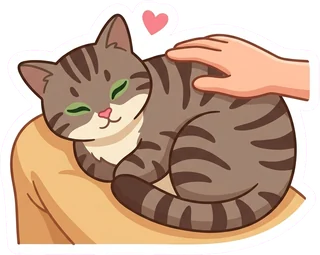
Spend more time close to your cat and you tend to feel better — and your oxytocin rises with your cat's.
Small study, big smileHow we know
Kyoto University followed 29 cats and 19 owners for a month (2026). Cats' and owners' oxytocin levels were positively correlated, and owners who spent more time physically close to their cats reported better moods. It shows a link, not a cause — a small, brand-new study.
Small study, big smile: A real study, but a small one — a promising hint, not the final word.
In a 20-year follow-up, people who had owned a cat were less likely to die of a heart attack.
Big-study backedHow we know
A US study followed 4,435 adults for about 20 years. Past cat owners had a lower risk of dying from a heart attack than people who never had a cat (relative risk 0.63). It's observational — cat people may differ in other ways — so it can't prove cats caused it.
Big-study backed: A large study or a review of many studies.
During the 2020 lockdown, living with an animal was linked with smaller drops in mental health and less loneliness.
Big-study backedHow we know
A UK survey of 5,926 people during lockdown found pet owners' mental health fell less and their loneliness rose less. People felt as close to their cats as dog owners did to their dogs.
Big-study backed: A large study or a review of many studies.
Most cat owners in a UK survey said their cat had a positive effect on their wellbeing.
Small study, big smileHow we know
In a 2011 Cats Protection and Mental Health Foundation survey of 621 people, 87% of cat owners felt their cat had a positive impact on their wellbeing and 76% said they coped with everyday life much better. It's a self-selected, self-reported survey, not a trial.
Small study, big smile: A real study, but a small one — a promising hint, not the final word.
People said they felt more energetic and positive — and less anxious or sad — after watching cat videos.
Peer-reviewed purrHow we know
An Indiana University survey of almost 7,000 people (2015) asked how cat videos made them feel. Viewers reported more energy and positive feelings and fewer negative ones. The feelings are self-reported.
Peer-reviewed purr: Published in a peer-reviewed science journal.
Babies who lived with two or more cats or dogs were less likely to become allergic by age six or seven.
Peer-reviewed purrHow we know
A Detroit birth study of 474 children found that living with two or more cats or dogs in the first year was linked with lower allergic sensitisation later. A 2018 Swedish study saw allergy fall as the number of pets rose. Both are observational, and neither helps a child who is already allergic.
Peer-reviewed purr: Published in a peer-reviewed science journal.
In a small trial, adopting a calm shelter cat was linked with more empathy and less separation anxiety in children with autism.
Small study, big smileHow we know
University of Missouri researchers ran a small randomised trial with 11 families who adopted temperament-screened shelter cats. Children showed more empathy and fewer problem behaviours, and families reported strong bonds. The authors call for larger studies.
Small study, big smile: A real study, but a small one — a promising hint, not the final word.
When cats want breakfast, their purr hides a little cry that sounds surprisingly like a baby's.
Small study, big smileHow we know
University of Sussex researchers recorded the “solicitation purr” of 10 cats and played it to 50 people, who rated it more urgent and less pleasant than an ordinary purr. A cry-like sound around 380 Hz is embedded in it; with the cry removed, it sounded far less urgent.
Small study, big smile: A real study, but a small one — a promising hint, not the final word.
Cats tell their own name apart from other words, even when a stranger says it.
Peer-reviewed purrHow we know
Cats that had stopped reacting to a list of ordinary words perked up again at their own name (Saito et al. 2019). An earlier study of 20 cats found they react more to their owner's voice than to strangers' voices.
Peer-reviewed purr: Published in a peer-reviewed science journal.
Blink slowly at your cat. It will often blink back — and cats warm faster to strangers who do it.
Peer-reviewed purrHow we know
Cats narrowed their eyes more when their owners slow-blinked at them, and approached a slow-blinking stranger more readily than one with a neutral face. Researchers suggest the slow blink is a positive signal between cats and people.
Peer-reviewed purr: Published in a peer-reviewed science journal.
About two in three cats are securely attached to their person — almost exactly the share seen in human infants.
Peer-reviewed purrHow we know
Using a “secure base” test adapted from infant research, Oregon State found 64.3% of kittens and 65.8% of adult cats securely attached to their caregiver, close to the 65% seen in babies.
Peer-reviewed purr: Published in a peer-reviewed science journal.
Offered a person, food, toys or smells, most cats chose time with the person.
Peer-reviewed purrHow we know
Pet and shelter cats were offered social interaction, food, toys and scents. Social interaction with a human was the most popular choice, followed by food — though individual cats varied.
Peer-reviewed purr: Published in a peer-reviewed science journal.
Your cat keeps a mental note of where you are, even when it can't see you.
Peer-reviewed purrHow we know
In tests with 50 cats, Kyoto University researchers found cats looked surprised when their owner's voice seemed to jump to a new spot in the room — as if they had a picture of where the owner should be.
Peer-reviewed purr: Published in a peer-reviewed science journal.
Cats living together seem to learn each other's names — Tejas probably knows Toofan's.
Peer-reviewed purrHow we know
House cats looked longer at a screen when a familiar cat's face didn't match the name they heard, suggesting they link companions' names and faces without training. Cats in a cat café didn't show this.
Peer-reviewed purr: Published in a peer-reviewed science journal.
Kneading starts at mum's side; grown-up cats do it when they feel safe and happy — sometimes on you.
Seen it, science named itHow we know
Kittens knead while nursing, and adults often knead when relaxed. Scent glands in the paws may also make it a way to mark a favourite bed — or person. The exact reasons aren't fully proven.
Seen it, science named it: Everyday cat behaviour that researchers have described and measured.
In Bengal, Shashthi — protector of small children — is shown riding a cat.
On the recordHow we know
Shashthi is worshipped as the goddess of birth and protector of children, recognised by the cat that is her vehicle. A Bengal painting from about 1880 in the Philadelphia Museum of Art shows her on her cat.
On the record: Documented history or culture — a museum record, an archaeological find or an archive.
On Cyprus, a cat was buried close to a person about 9,500 years ago — possibly the oldest known pet cat.
Peer-reviewed purrHow we know
Archaeologists found an eight-month-old cat buried about 40 cm from a human at Shillourokambos, Cyprus. Whether it was a pet or only tamed is still debated.
Peer-reviewed purr: Published in a peer-reviewed science journal.
Cats take the shape of their container — so a physicist asked, half-seriously, whether they're liquid.
Full zoomies
Ig Nobel certifiedHow we know
Marc-Antoine Fardin used rheology, the science of flow, to ask the question. His answer: it depends how long you watch. The playful essay won the 2017 Ig Nobel Prize in Physics.
Ig Nobel certified: Won an Ig Nobel Prize — research that first makes you laugh, then makes you think.
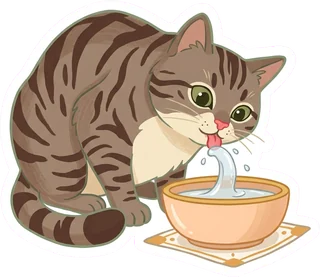
Cats don't scoop water — they flick a column of it up with the tip of the tongue and snap it shut.
Head tilt
Peer-reviewed purrHow we know
MIT engineers filmed cats at high speed. The tongue barely touches the surface, pulls up a column of water by inertia and the jaws close on it — about four laps a second in a house cat.
Peer-reviewed purr: Published in a peer-reviewed science journal.
Many animals will work for food even when free food is around. Most cats? Not interested.
Tail flick
Small study, big smileHow we know
This is called contrafreeloading. In a UC Davis study of 17 indoor cats, cats ate more from a free tray than from a food puzzle, though some did use the puzzle.
Small study, big smile: A real study, but a small one — a promising hint, not the final word.
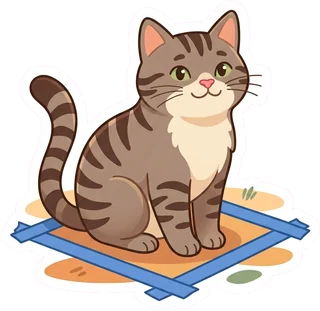
Cats sat in a square drawn only with its four corners as often as in a real square.
Full zoomies
Small study, big smileHow we know
In a citizen-science study, owners taped shapes on the floor. Cats chose the “illusory” square (only the corners drawn) as often as a full square, and more than a control shape. Only 30 cats finished every trial, so it needs repeating.
Small study, big smile: A real study, but a small one — a promising hint, not the final word.
Cats purr at 25–150 Hz — close to frequencies used in bone therapy. Healing? Still just an idea.
Head tilt
Promising, not provenHow we know
Cats purr when content but also when hurt or frightened. A 2001 acoustics study of 44 cats, big and small, found strong purr frequencies between 25 and 150 Hz, and the author proposed that purring might aid healing. It's a conference abstract and has never been tested.
Promising, not proven: An idea scientists are still testing — fun to know, not a fact yet.
Cat voice boxes can purr on airflow alone, thanks to tiny pads in the vocal folds.
Head tilt
Small study, big smileHow we know
University of Vienna researchers tested the voice boxes of 8 cats outside the body: air alone made them vibrate at purring rates (25–30 Hz). Pads of tissue up to 4 mm wide in the vocal folds seem to make the low purr possible.
Small study, big smile: A real study, but a small one — a promising hint, not the final word.
A cat parasite makes infected rats lose their fear of cats. In people? Little link to mental illness was found.
3 a.m. chaos
Peer-reviewed purrHow we know
Toxoplasma gondii breeds in cats and can make infected rats drawn to cat smell. A New Zealand study of 837 people found little link between infection and psychiatric disorders, and iCatCare says people mostly catch it from food or soil. Empty the litter tray daily; pregnant women shouldn't handle it.
Peer-reviewed purr: Published in a peer-reviewed science journal.
Male cats tend to lead with the left paw, females with the right.
Head tilt
Peer-reviewed purrHow we know
Queen's University Belfast watched 44 pet cats reach for food and step down stairs: males tended to prefer the left paw and females the right, matching an earlier study.
Peer-reviewed purr: Published in a peer-reviewed science journal.
In parts of India a black cat crossing your path is a bad omen. The cat would like a word.
Tail flick
Dadi-approved, science pendingHow we know
Tradition says to go back home and sip some water before setting out again. A university folklore archive notes the custom is now kept mostly by elders. No evidence links cats — of any colour — to luck.
Dadi-approved, science pending: A belief from Indian homes and folklore — charming, not proven.
Scroll, and each part steps out with one true thing about it.
Ears: a very wide radio
Cats hear from about 48 Hz up to about 85 kHz — one of the broadest hearing ranges of any mammal, far above our ~20 kHz. Heffner & Heffner 1985, Hearing Research
In tests with 50 cats, they looked surprised when their owner's voice seemed to jump to a new spot — they keep track of you even out of sight. Takagi et al. 2021, PLoS ONE
Mouth: physics, but no sugar
A cat laps about four times a second, pulling up a column of water with the tip of its tongue — and a broken gene means it probably can't taste sweet. Reis et al. 2010, Science
Throat: the purr engine
Cat voice boxes vibrated at purring rates (25–30 Hz) with airflow alone, helped by soft pads in the vocal folds. Herbst et al. 2023, Current Biology
 Good for you